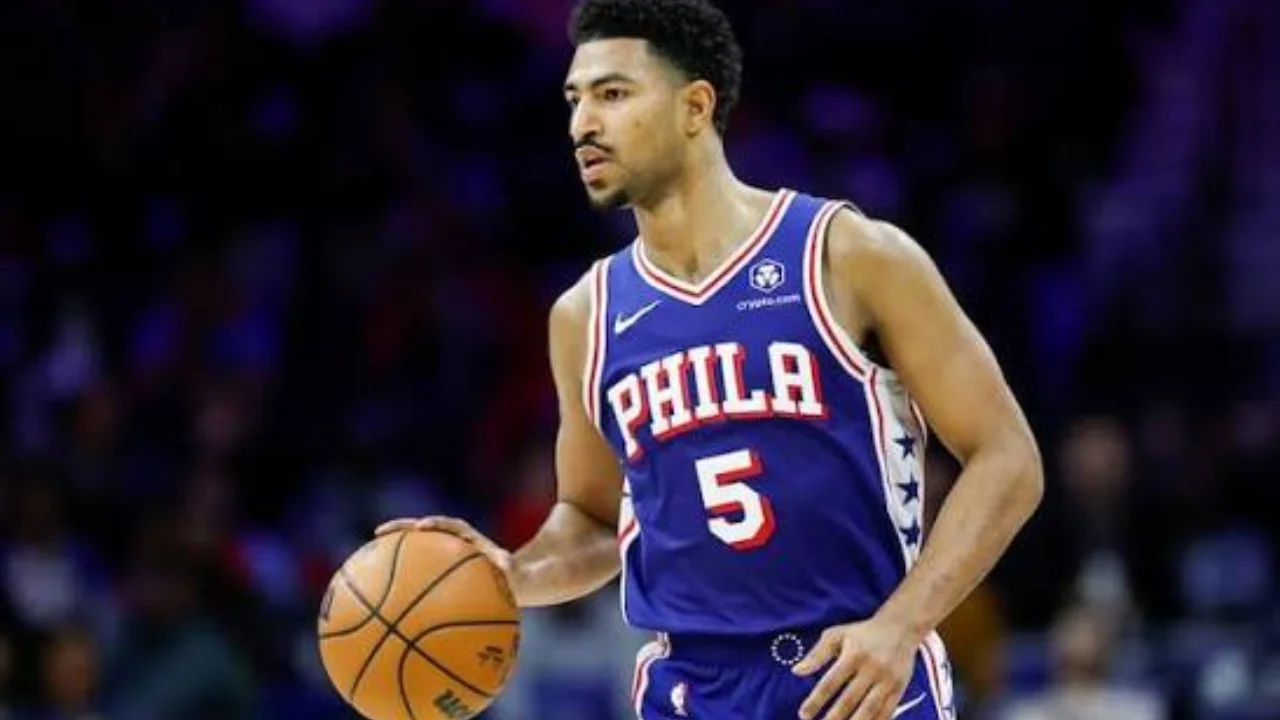
Quentin Grimes’ restricted free agency saga has finally reached a conclusion, at least for now.
The Philadelphia 76ers guard has accepted an $8.7 million qualifying offer to return to the team for the 2025-26 season. His agent, David A. Bauman, confirmed the decision, bringing an end to months of uncertainty surrounding the young guard’s future in Philadelphia.
The agreement also includes a full no-trade clause for the season, giving Grimes an unusual level of security as he heads into what could be one of the most important seasons of his NBA career.
The one-year agreement does not completely settle the long-term question, however. Grimes will become an unrestricted free agent next summer, meaning the guard will once again have a chance to test the market.
For Philadelphia, the immediate outcome is simple. The team keeps a young player who showed major scoring potential after arriving at the trade deadline. For Grimes, the decision gives him another season to prove that his breakout stretch was not a short-term hot streak.
Quentin Grimes Chooses the $8.7 Million Qualifying Offer
Grimes had until the deadline to accept the Sixers’ qualifying offer, and the decision ultimately came after months of difficult negotiations.
Rather than agree to a long-term contract, Grimes chose the one-year option worth $8.7 million.
The move gives both sides a temporary solution.
Philadelphia gets another season with a guard who showed he can produce at a high level. Grimes gets another opportunity to improve his value before entering unrestricted free agency.
The full no-trade clause is also an important part of the agreement.
That protection means Grimes will not have to worry about being moved during the season without his approval. After such a complicated offseason, that level of control could be particularly valuable.
The decision also means Grimes will have the chance to focus on basketball again.
Grimes Had a Breakout Stretch With Philadelphia
The reason this negotiation became so complicated was simple: Grimes played extremely well after joining Philadelphia.
In 28 games with the Sixers, he averaged 21.9 points, 5.2 rebounds and 4.5 assists.
Those are significant numbers for a player who was still trying to establish himself as a consistent NBA contributor.
Grimes showed that he could do much more than simply hit outside shots.
His scoring ability, playmaking and rebounding gave Philadelphia another versatile guard who could contribute in several areas.
That production also changed the conversation about his future.
Before the breakout stretch, Grimes was viewed as a promising young player. After averaging nearly 22 points per game in Philadelphia, the question became how much that production should be worth on a long-term contract.
That difference in perception played a major role in the negotiations.
Why the Long-Term Negotiations Became Difficult
Grimes’ agent believed the guard deserved a much larger long-term contract.
Bauman said he believed Grimes’ market value was somewhere between $20 million and $25 million per year.
That would put Grimes in a significantly different financial category from the qualifying offer he eventually accepted.
The agent pointed to the four-year, $100 million contract that Josh Giddey signed with the Chicago Bulls as an example of the kind of deal he believed Grimes could command.
However, the market did not develop that way.
The Sixers and Grimes remained far apart on long-term options, eventually making a one-year agreement more realistic.
The situation became even more complicated when there were conflicting accounts about whether Philadelphia had formally offered a four-year, $39 million contract.
Bauman said the Sixers had made such an offer.
A team source familiar with the negotiations strongly disputed that characterization and said discussions had recently centered on a one-year contract without a no-trade clause.
That disagreement became a public part of the offseason saga.
The Timing Was Unfortunate for Grimes
One of the biggest factors working against Grimes was the timing of his restricted free agency.
His breakout came after the trade deadline, meaning he had only 28 games with Philadelphia to demonstrate his new level of production.
That created a difficult situation.
Teams had limited evidence of whether Grimes could maintain those numbers over an entire season. At the same time, his performance was strong enough to create expectations for a much bigger contract.
The timing was also affected by the NBA’s changing financial landscape.
The league’s new collective bargaining agreement introduced tougher penalties for teams operating above certain salary thresholds, commonly known as apron restrictions.
Those rules reduced the number of teams with the flexibility or willingness to spend aggressively.
That hurt the negotiating power of several restricted free agents.
Grimes Was Not the Only Young Player Stuck in Limbo
The unusual free agency situation extended beyond Philadelphia.
Other restricted free agents also struggled to find major offers.
Jonathan Kuminga remained in an uncertain position with the Golden State Warriors before agreeing to a two-year, $48.5 million contract.
Cam Thomas accepted his qualifying offer from the Brooklyn Nets in early September.
Giddey eventually secured his four-year, $100 million deal with Chicago.
One notable common factor was that none of those players, including Grimes, received an offer sheet from another team that their current club would have the opportunity to match.
That lack of outside competition made it much harder for players to force their original teams toward bigger contracts.
For Grimes, the qualifying offer ultimately became the clearest path forward.
The Sixers Still Have an Advantage Next Summer
Although Grimes will become an unrestricted free agent next offseason, Philadelphia has not completely lost its leverage.
The Sixers will retain his Bird rights.
That is important because it gives the team an advantage when trying to negotiate a new contract.
If Grimes has another strong season, Philadelphia should have an opportunity to make a competitive offer and keep him in the organization.
The situation could also look very different across the league next summer.
A larger group of teams is projected to have salary-cap space in the 2026 offseason.
That could create a much healthier market for Grimes.
Instead of negotiating in a restricted free agency environment where fewer teams have flexibility, he could enter unrestricted free agency with multiple potential destinations.
If his production continues to rise, that could significantly increase his bargaining power.
The No-Trade Clause Is Important for Grimes
The full no-trade clause gives Grimes another layer of control during the upcoming season.
He spent part of the offseason dealing with uncertainty over his contract, so having guaranteed control over his destination could be meaningful.
The clause also allows him to focus on his performance without wondering whether a trade could suddenly change his situation.
For the Sixers, it means they have committed to keeping Grimes for the season unless he agrees otherwise.
That creates clarity for both sides.
Philadelphia knows it will have his services, while Grimes knows where he will be playing.
Now the attention can shift toward what happens on the court.
Philadelphia Has an Interesting Young Backcourt
Grimes will return to a Sixers backcourt that has plenty of young talent.
Tyrese Maxey is already signed to a long-term max contract and has become one of the team’s central pieces.
Jared McCain is another promising young guard, although he suffered a torn ligament in his right thumb during a workout and underwent surgery.
The Sixers also selected VJ Edgecombe with the third overall pick in the draft.
That gives Philadelphia a collection of young guards with different skill sets.
Grimes’ return adds another proven option to that group.
The challenge for the coaching staff will be figuring out how the players fit together and how many opportunities each guard receives.
Grimes’ ability to score and contribute as a playmaker could help him carve out an important role.
Grimes Will Have Something to Prove
The 2025-26 season could be extremely important for Grimes.
He has already demonstrated that he can produce at a high level over a 28-game stretch.
Now he needs to show that he can sustain that level across a full NBA season.
That does not necessarily mean averaging 21.9 points every night.
Instead, consistency will be the key.
Can he remain an efficient scorer? Can he create opportunities for teammates? Can he contribute on the glass? Can he defend effectively while carrying a larger offensive responsibility?
Those questions will influence his next contract.
A strong season could put him in position to receive the kind of long-term deal his agent believes he deserves.
A less productive year could make the market much more complicated.
The Sixers Also Have a Chance to Benefit
Philadelphia may view the one-year agreement as a positive outcome.
The organization gets another season to evaluate Grimes before making a major long-term commitment.
That is valuable because his breakout period came over a relatively small sample size.
If Grimes proves that his production was sustainable, the Sixers can decide whether to invest heavily in him next summer.
If his numbers decline, Philadelphia will have more information before committing significant money.
The arrangement therefore gives both sides another year to learn more.
Grimes can prove his value, while the Sixers can determine whether he fits their long-term plans.
Grimes’ Absence Added Another Layer to the Story
The contract situation also affected Grimes’ involvement with the team during the early part of the season.
He had been absent from team activities after Philadelphia officially reconvened.
That included missing media day, two practices and the team’s trip to Abu Dhabi for two preseason games against the Knicks.
His agent said the absence should not be viewed as a holdout.
The unresolved contract situation made it difficult for the team and player to move forward normally, but the expectation was that Grimes would join the team once Philadelphia returned from overseas.
With the contract now settled, that uncertainty should begin to disappear.
A One-Year Deal Could Work Out for Everyone
At first glance, a one-year qualifying offer might appear to be a disappointing outcome for Grimes after his breakout season.
But there is another way to look at it.
If he believes his market value is significantly higher than $8.7 million annually, another strong season could give him the chance to prove it.
Instead of accepting a long-term contract below his expectations, Grimes can bet on himself.
That carries some risk, but it also offers potentially greater rewards.
For Philadelphia, the arrangement keeps an important young player while avoiding an immediate long-term commitment.
That makes the agreement a reasonable compromise after a difficult offseason.
Quentin Grimes’ Next Chapter Starts Now
The contract dispute may be over, but Grimes’ bigger story is just beginning.
He returns to Philadelphia on an $8.7 million deal with a full no-trade clause, knowing that next summer could bring an entirely different free agency experience.
His breakout performance already changed how teams view him.
Now he has the opportunity to prove that those 28 games were a preview of what he can become rather than simply a hot stretch.
The Sixers have reasons to believe in him. Grimes has reasons to believe in himself.
With Maxey, Edgecombe and McCain also part of an intriguing young backcourt, Philadelphia will have plenty of options to consider.
For Grimes, though, the mission is straightforward.
Play well, stay healthy, help the Sixers win and let the next contract take care of itself.
After months of uncertainty, he finally has a clear path forward. And when unrestricted free agency arrives next summer, Grimes could have a much stronger position than he did when this offseason began.