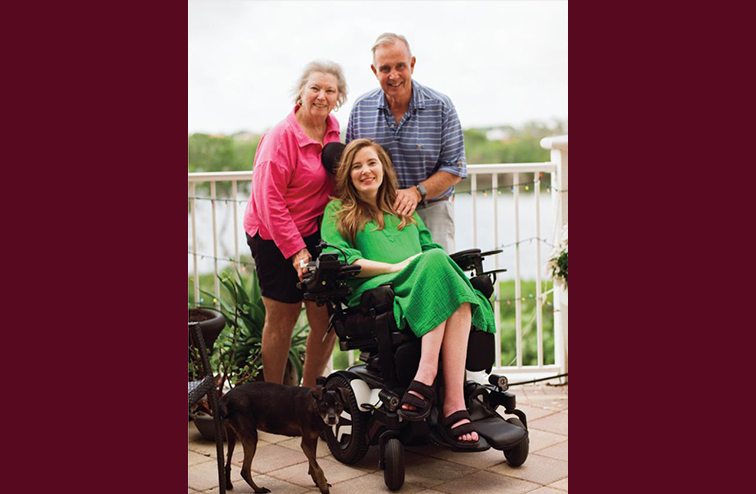
Brooke Eby’s family played a central role throughout her four-year battle with ALS, providing practical care, emotional support and encouragement as she turned her personal experience into a powerful platform for disability and ALS advocacy.
As the disease progressively affected her mobility, Eby increasingly relied on the people closest to her. In August 2024, she moved back into her parents’ home in Potomac, Maryland, allowing her family to become more directly involved in her everyday care.
Her parents, siblings and extended family were not simply bystanders during her illness. They helped adapt her surroundings, organize her care and support the fundraising and awareness work that became an important part of her public life.
Her Parents
Cliff Eby
Cliff Eby, Brooke’s father, became one of her primary caregivers. A civil engineering graduate of Lehigh University, he brought his professional problem-solving background into the family’s efforts to make everyday life more accessible for his daughter.
As Brooke’s physical abilities changed, the family’s home had to change with her. Cliff helped develop and implement practical modifications that made it easier for Brooke to move around safely and use her wheelchair.
His engineering background proved particularly useful when ordinary household solutions were no longer enough. He approached many of the challenges created by Brooke’s declining mobility as problems that could be solved through creativity and adaptation.
Cliff also became a familiar presence to Brooke’s online followers. His appearances in her social media videos gave audiences glimpses of the family dynamic behind the advocacy work.
Their relationship often contained the humor that characterized Brooke’s content, even while they were dealing with difficult circumstances.
Ginny Eby
Ginny Eby, Brooke’s mother, was another key part of her daily support system.
While Cliff frequently handled practical and engineering-related challenges, Ginny was deeply involved in the emotional and organizational side of Brooke’s care.
She helped keep track of medications and assisted with the complicated routines that accompanied Brooke’s changing medical needs. As ALS progressed, managing daily life required increasing coordination, patience and flexibility.
For Brooke, having both parents nearby provided a dependable support structure during a period when independence was becoming increasingly difficult.
Her Brother
Brooke was the youngest of three children, growing up with an older brother and sister.
Her brother, Chris Eby, is a Lehigh University engineering graduate who later built a career in finance. He remained actively involved in supporting Brooke’s advocacy and fundraising efforts.
Chris’s support extended beyond the family home. He helped rally people around Brooke’s campaigns and the larger effort to raise awareness and money for ALS research.
Brooke sometimes joked about being the youngest child in a family with significantly older siblings. Her humor about family life became another recurring part of the personality she showed online.
Her Sister
Sarah Eby, Brooke’s sister, was also closely involved in her support network.
Sarah helped with Brooke’s day-to-day needs and remained connected to the family routines that became increasingly important after Brooke moved back home.
Weekend gatherings gave Brooke opportunities to spend time with family members away from the medical responsibilities that dominated much of her daily life.
Her sister’s involvement also reflected the wider way the Eby family responded to Brooke’s illness. Rather than leaving caregiving to one person, relatives contributed in different ways according to what they could offer.
Extended Family
Brooke’s support network extended beyond her parents and siblings.
Her sister-in-law, nieces and nephews became part of the wider family effort surrounding her advocacy and fundraising. Their participation gave Brooke additional sources of encouragement while also helping spread awareness of ALS.
Some family members took an especially active role in fundraising.
A young niece organized local bake sales, while Brooke’s sister-in-law helped organize tennis tournaments. These efforts contributed to the family’s broader fundraising campaign, which ultimately generated more than $1 million for ALS research.
For Brooke, the fundraising was about more than collecting donations. It was connected to her determination to make something meaningful out of her experience with ALS and help researchers work toward better treatments and, eventually, a cure.
Life at Home
Moving back to her parents’ house represented a major change in Brooke’s life.
By August 2024, declining mobility had made living independently increasingly difficult, and returning to the family home allowed her parents and other relatives to provide more consistent assistance.
The household effectively became a coordinated care environment.
Wheelchair accessibility, medication schedules, physical assistance and other everyday needs all had to be considered. At the same time, Brooke continued creating content and speaking publicly about life with ALS.
Her family helped make it possible for her to maintain that public voice.
More Than Caregivers
One of the most striking aspects of Brooke’s family story was that her relatives were not simply caregivers.
They became partners in her advocacy.
Her father helped solve accessibility problems. Her mother helped coordinate her care. Her brother supported campaigns and fundraising. Her sister contributed to her everyday support. Younger relatives and extended family members helped raise money and awareness.
That collective involvement allowed Brooke to continue focusing on the causes that mattered to her while knowing she had people around her who understood the realities of her condition.
Her Legacy
Brooke Eby’s family became an important part of the story she shared publicly about ALS.
Her social media audience saw glimpses of the people behind the scenes, particularly her father, whose appearances became familiar to followers. But the wider family contributed in ways that were sometimes less visible, helping with care, fundraising and everyday life.
The Eby family’s support helped Brooke continue advocating for ALS awareness while navigating the profound physical challenges caused by the disease.
Her story ultimately became about more than illness. It was also about family, adaptation, humor and the determination to remain engaged with life despite circumstances that continually changed.
For Brooke, her parents, siblings, nieces, nephews and extended relatives provided something that could not be measured simply by caregiving hours or fundraising totals: a constant sense of connection and family support throughout one of the most difficult periods of her life.